Showing posts with label reading. Show all posts

Wednesday, September 28, 2016

Banned Books Week 2016

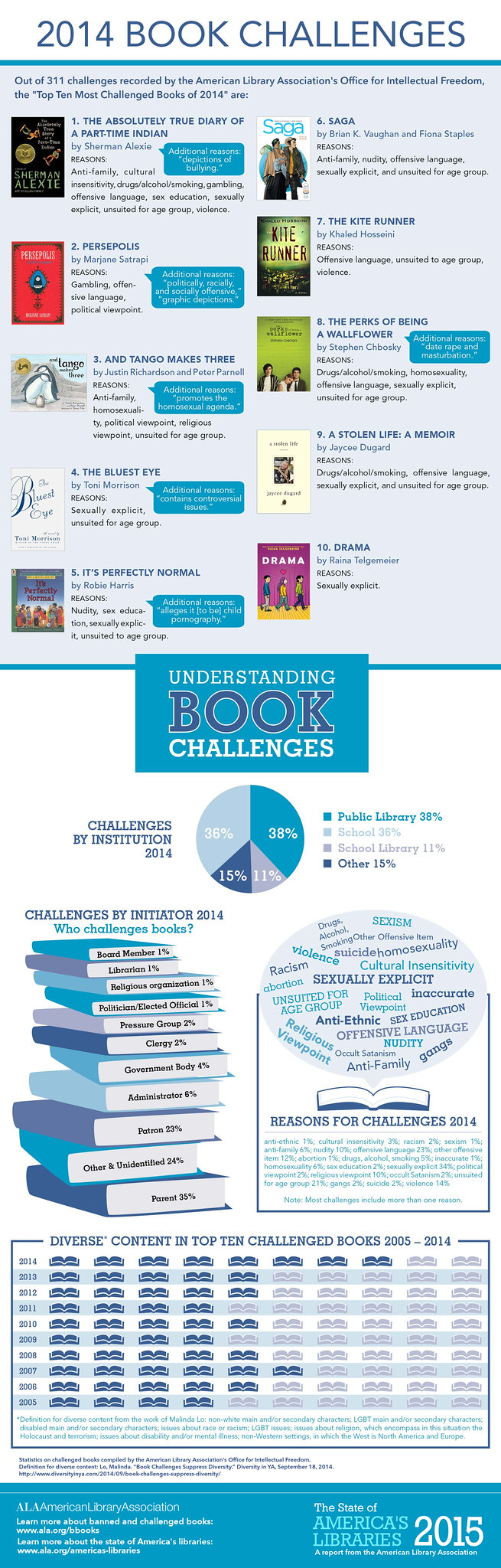
Happy Banned Books Week 2016! While we're halfway through the week, there's still plenty of time to celebrate by reading one of your favorite banned or challenged books. You can also read a book from 2015's most banned and challenged list, which you can find on the ALA website.


infographic by the ALA

A notable but sad trend that 2015's list illustrates is the over-representation of books about issues concerning diversity. This was also the case in 2014, when the ALA noted that 80% of the most challenged books with "diverse content." To further show this issue, the ALA even created an infographic on this:

Fittingly, this year's Banned Books Week spotlight is on banned books that feature diversity, and I hope that this brings attention to this matter. While people fear the other and the unknown, banning books is perhaps the most counterproductive way to deal with topics that seem strange and frightening. If recent events have taught us anything, it is that insulating ourselves from what is unknown doesn't protect us. Instead, it keeps us ignorant and afraid, and this leads to blind, and often unfounded, anger. Perhaps if, instead of banning books like I Am Jazz or The Curious Incident of the Dog in the Night-Time, it would be helpful to read these texts and get a better sense of other people's perspectives and experiences. To quote Atticus Finch from To Kill a Mockingbird, another book that is a regular on banned and challenged lists, "You never really understand a person until you consider things from his point of view... Until you climb inside of his skin and walk around in it." In other words, rather than avoiding or prohibiting the things that scare us, it's important to face these issues head on and try to gain some empathy, or at least some perspective, on the thing that we fear.

Monday, August 29, 2016

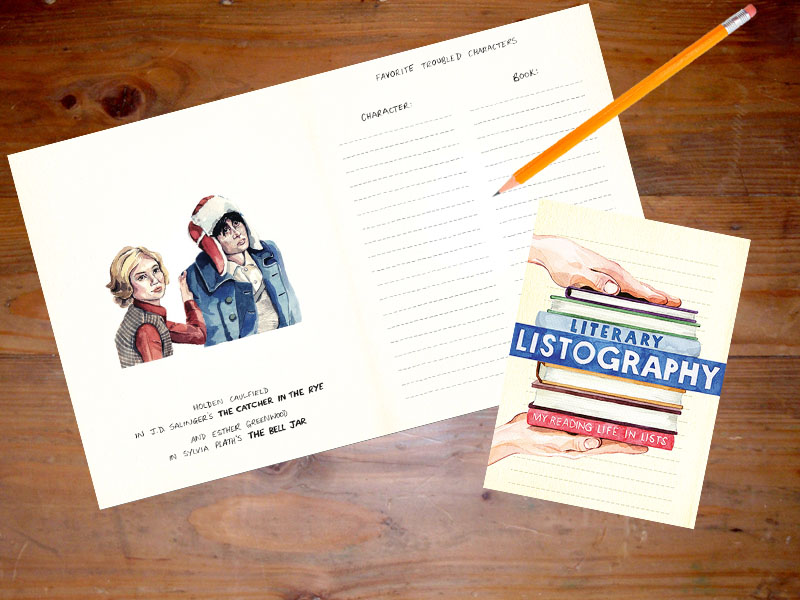
Book Review: Literary Listography

I would consider myself a fairly organized person, and as such, I tend to gravitate towards lists. While I have several list apps, I also like and use pen and paper lists. Given this and my love of books, Literary Listography seemed like a natural fit for me.

For those aren't familiar with the Listography books, they are an offshoot of the website and app that encourages users to create and share public lists about anything (you can read about it on the Listography website). Since the first Listography book was published in 2007, there have been 12 books in the series that focus on different themes, including friendship, food, and film.

Picture from Listography.com
Unlike other books, the Listography books is very much driven and created by the reader, and Literary Listography is no exception. Billed as a "selection of lists chosen just for the book lover," the book includes 70+ lists that are designed to delight and intrigue any bibliophile. Rather than providing you with lists of books to explore, this book relies on you to interact with it and create lists based on the prompts. With prompts ranging from the expected ("My Favorite Authors") to the atypical ("Fictional Crimes I've Witnessed"), this book is fun and thought provoking. Some of my favorite prompts included "Fictional Characters I'd Go on a Date With" (let's be honest - if you love books, you've probably considered this. For the record, my list includes Gilbert Blythe from the Anne of Green Gables books), "Cultures I've Immersed Myself in Through Literature," and "Words I Love and Hate the Sound Of."

Besides the great list ideas, Literary Listography had a number of features that I appreciated and that added to the experience. Each prompt is accompanied by a full-color picture depicting a book related to the prompt it faces. For instance, a picture of a backpack and hiking books symbolizing Cheryl Strayed's Wild goes with the prompt "My Favorite Memoirs and Autobiographies." Besides this, the physical features of the book make it a pleasure to use. The pages have a nice weight and texture that hold up to even fountain pen ink and resist smudges, and the book pages lie flat, which makes it easy to write inside.

If  you are looking for a book to help you record your reading life and thoughts, Literary Listography could be the perfect book for you. It would also make a great gift for the book lover in your life (just be prepared for him or her to become preoccupied by it).

Monday, August 8, 2016

Book Review: "Defying the Nazis: The Sharps' War"


Following any of the horrific events that have become all-too-common in modern society, someone on social media inevitably shares Mr. Rogers’s advice to “’Look for the helpers. You will always find people who are helping’… I am always comforted by realizing that there are still so many helpers – so many caring people in this world.” These words are true, but after so many tragedies and so many Facebook posts, it becomes easy to dismiss or forget about them. Artemis Joukowsky’s Defying the Nazis: The Sharps’ War provides clear proof of the veracity of this sentiment. The book tells the true story of Waitstill and Martha Sharp, who took on the enormous task of helping refugees in Europe as the Nazis were coming to power and World War II was starting. It is also the companion book to the Ken Burns documentary that will be airing on PBS in September.

While the Sharps seemed like an ordinary couple, they had an extraordinary sense of duty that led them to accept the mission put forth by the American Unitarian Association to go to Prague, Czechoslovakia on the eve of the Nazi invasion. Despite having two young children, Waitstill and Martha go to Prague, learn ways of circumventing the obstacles in their way, outwit the Gestapo, and work to help those who are being oppressed and hunted by the Nazis. After leaving Prague and having a short sojourn at home, they return to Europe during World War II to continue helping those they can.

In many ways, this story seems too fantastic to be true, but Joukowsky, who is the Sharps’ grandson, does an excellent job providing research and facts as support. In some instances, the number of names, dates, and references can weigh down the narrative, but the text’s focus never wavers for long. Joukowsky’s writing style also does not veer far away from the facts. If it is not verified in Martha and Waitstill’s correspondence, excerpts of which are included, or through his interviews with him, the text takes pains not to dramatize the events. This helps further establish Joukowsky as a trustworthy author, but it also can make the narrative a little dry, which is surprising given the suspense that is built into the story. However, despite these minor issues, the book moves quickly and leaves the reader wanting to find out what happened to the Sharps. Additionally, there are places where the straightforward narration works to the book's advantage. The description of the Nazi invasion of Czechoslovakia is especially sobering; any further dramatization would have detracted from the horror of the event.

Another aspect that reinforces the book’s reliability is that Joukowsky examines some of the more everyday facets of the Sharps’ lives. A prime example of this is the tension that exists between the good that Martha wanted to do by helping refugee children and the fact that she did this at the expense of spending time with her own children. Also, rather than closing with the Sharps’ second mission to Europe, Joukowsky follows them post-World War II, as they grow further apart both literally (Martha did a lot of travelling on the lecture circuit, while Waitstill returned to Prague to work for the American Committee for Relief in Czechoslovakia) and figuratively and after their marriage ends. In a perfect world, their bond would have been galvanized by the shared experiences in Europe and would have remained strong. Joulowsky’s exploration of its disintegration reinforces the reality of this story; it is not a fairy tale or fable but the story of two seemingly ordinary people who were able to accomplish extraordinary things under great duress and in the face of seemingly insurmountable obstacles.

All in all, Defying the Nazis is a worthwhile and important book. Besides providing the Sharps with the attention they so richly deserve for their heroic actions and showing the personal cost that can come with such actions, it also illustrates how people can rise to the occasion. In short, it is another reminder for us to look for the helpers.

Saturday, January 9, 2016

My Top Reads from 2015

I apologize for my lengthy absence - the end of the year is always rough in academia. Between the holidays, the end of the semester, and a five-day conference, November and December were a little crazy. However, now that the craziness is more manageable, I wanted to write a post on my favorite reads from last year. I had a great reading year in 2015 (I read over 80 books). This was aided by a Scribd subscription for part of the year (I used it in the summer, but I didn't feel like I could justify having it once school started back) and a seven-day cruise where I had very limited internet access.

Besides the number of books I read, what is even more exciting to me is that most of them were quite enjoyable. Below are my favorite books that I read during the past year. While most of them were published before 2015, the ones that I included in this list were new to me (I'm an avid re-reader, but I'm not going to list them since I've likely written about them on my blog before :).

The Devil in the White City: Murder, Magic, and Madness at the Fair that Changed America - This book was on my "To be read" list for a long time.I finally picked it up last year, and my only regret is waiting so long to read it. In it, Erik Larson provides a gripping account of the 1893 World's Fair in Chicago. Through alternating chapters, he tells about the fair's construction and the serial killer who took advantage of the fair to murder a number of people in horrific ways. My one piece of advice when reading this book is not to read it late at night. Reading about a murder house is disconcerting at any time, but it is especially troubling at 1:00 am.

Fun Home - Allison Bechdel was our keynote speaker at NCTE this year, and when I had the opportunity to buy some of her books for her to autograph, I jumped at the chance. While I liked Are You My Mother?: A Comic Drama, I loved Fun Home, which is examines her relationship with her father and which was the basis for the musical that won the 2015 Tony for Best New Musical.

Drama - I really like Raina Telgemeier's work and was excited to read her graphic novel about middle school students putting on a musical. The story focuses on a female tech person, which made it especially enjoyable for me (in high school and college, I spent a lot of time working backstage on various plays). It touches upon friendship, crushes, and LGTBQ issues without getting too heavy. Overall, it is a lovely, humorous read.

The Secret History of Wonder Woman - Jill Lepore's look at Wonder Woman's origin is critically acclaimed for a reason. The main focus is on William Moulton Marston, Wonder Woman's creator, and Lepore does an excellent job taking Marston, who could easily seem like an unsavory and over-the-top individual, and making him multifaceted and nuanced.

Hope Against Hope: Three Schools, One City, and the Struggle to Educate America's Children - Since I feel inundated with information on education at work, I often bypass reading about it in my spare time. However, I picked this book up at a library book sale, and once I started reading it, I couldn't put it down. Besides providing a thoughtful look at the state of education in post-Katrina New Orleans, a city that has had many issues with their public education system, the author does a great job presenting all sides to controversial topics like Teach for America and charter schools.

Wednesday, October 21, 2015

Book Review: "The League of Regrettable Superheroes"

I’m not a comics expert, but I have a great affinity for reading about comic books of years past. One of my favorite aspects of reading about these books is the often well-intentioned but ridiculous missteps that have occurred, such as an entry in the Superman universe that Glen Weldon gleefully (and affectionately) recounts on the NPR site where Jimmy Olsen travels back in time and starts a Beatles craze in ancient Judea. “The League of Regrettable Superheroes” by Jon Morris is dedicated to celebrating the wacky hijinks and preposterous storylines of yesteryear. However, rather than focusing on the missteps of well-known series, Morris’s book focuses on lesser-known and less-successful superheroes. Some have dubious origins (Captain Tootsie, a superhero/advertisement for Tootsie Rolls) while others seem to have been designed to take advantage of a trend popular at the time (Morris points out that Magicman, which debuted in 1965, was an attempt to cash in on shows like “Bewitched” and “I Dream of Jeannie”). In almost all cases, the superheroes are indeed regrettable, but Morris has palpable fondness for them even as he acknowledges how ridiculous and ill-conceived they are.

The entries are organized into three parts – The Golden Age (1938 – 1949), the Silver Age (1950 –1969, a time that Glen Weldon refers to as The Crazypants Years), and the Modern Age (1970 – present day). Most entries are two pages in length, with a page dedicated to humorously and wryly describing the superhero and the other page featuring lavish color pictures from the comics (a few entries have four-page spreads, with the extra pages consisting mostly of pictures). As a sidebar, Morris includes a few quick facts on each hero, such as the creator and the debut info, as well as some snarky commentary (for instance, The Conqueror’s sidebar includes “Last seen: Moving inexorably toward Berlin”). While the setup might frustrate those who want further information, the format works very well for readers who want a general overview of the comics without too much minutiae to bog down the proceedings. Additionally, the use of full-color pictures throughout the book (in fact, all of the pictures are printed in color – Quirk does not skimp on the printing or layout) provide further insight into the heroes, as Morris wisely uses his subjects’ inherent insanity and inanity to speak for themselves. These features also make “The League of Regrettable Superheroes” perfect as a quirky and fun coffee-table book.

In short, if you are looking for a serious and in-depth examination of failed comic book characters, then “The League of Regrettable Superheroes” might not be for you. However, it is perfect if you want an entertaining, approachable, and amusing look at unsuccessful or inept attempts at finding the next Superman or Batman.

Monday, October 5, 2015

Literary Halloween Costumes: 2015 Edition

Every year, I consider not doing a literary Halloween post. After eight posts, it can be a little challenging to come up with something relatively new and/or different. However, after thinking about it and taking a quick look at my blog stats, I find that I can't resist. Here are a few new costume ideas from classic and not-so-classic literature.

Lady Macbeth from Macbeth - Unlike some characters, there is no single, indelible image that is Lady Macbeth, which can be a bonus (even if it does require that you explain your costume to people throughout the evening). For Lady Macbeth, you can go with a more formal, regal look (think velvet gown and elaborate hair) or a more severe ensemble (whenever I picture Lady Macbeth, Judy Dench's version comes to mind). Perhaps her most recognizable outfit is the nightgown associated with the sleepwalking scene, which would allow you to be very comfy (layers would be a good thing) and mutter "Out, damned spot! Out, I say!" all evening.

The Girls (Bridget, Carmen, Tibby, and Lena) from The Sisterhood of the Traveling Pants - This idea works best if you have three female friends who want a group costume but no one wants to spend a lot of time or money coming up with one. The main thing each person needs is a comfortable pair of flattering jeans. After that, personalize the looks based on the different characters. Bridget needs long blonde hair (or, if you want to go for the second book, poorly dyed black hair), a soccer jersey or flirty top (when she's trying to get Eric's attention), and maybe a soccer ball. Carmen is trendier and curvier than her friends. Tibby might have a blue streak in her hair, a Wallman's (or Walgreen's) smock/vest, a nose piercing, and a somewhat sour expression. Lena dresses on the preppier end of the spectrum and tries to blend in.

The Narrator from "The Raven" - Our knowledge of the unnamed narrator of Poe's "The Raven" is limited, but he would be easy to recognize because of the raven. Given the late-in-the-day setting, slippers, pants, a shirt, and a nice robe would suffice. However, you would also need a stuffed raven to place on your shoulder (add the word "Nevermore" on a speech bubble coming out of the bird's mouth for further detail) or a friend to dress up as a raven to accompany you on your Halloween adventures. You might also have a picture of Lenore to look at and sigh over throughout the night.

Princess Elizabeth from The Paper Bag Princess - Elizabeth makes a refreshing change from the typical princess archetypes in their tiaras and fancy dresses. Additionally, she would be a (relatively) easy last-minute costume. As the book title suggests, she wears a paper bag instead of a gown and goes on adventures. Given the (probably) chilly temperatures and decency laws, I don't recommend that you only wear a paper bag. Instead, wear tights (or shorts or pants, depending on your preferences) as well as a tank top or long-sleeved shirt underneath your paper bag (or brown paper) dress. While Elizabeth's dress was simple, you could go all Project Runway with the idea and make your creation a more elaborate affair by styling your paper bag just so.

Scarlett O'Hara and Rhett Butler from Gone with the Wind - I can't believe that I haven't yet spotlighted Gone with the Wind here yet, but better late than never. I think that part of reluctant to include the book is that the movie, its costumes, and its overall look are so well known, but rather than run away from it, you could also embrace the iconography. Scarlett and Rhett (typically) require some planning, but the effect is well worth it. Depending on time, budget, and weather (seriously, running around in a hoop skirt and ballgown wouldn't terribly fun in 80 degree weather), you can go super-fancy in one of Scarlett's well-known, sumptuous ensembles, such as her green velvet dress (made from Tara's curtains), her red velvet party gown, or her picnic dress (Edelweiss Patterns has some beautiful pictures of a homemade version). To be a dapper Rhett, a period suit, preferably with tails and a vest, would do nicely. However, if you are short on time or actually want to fit into your car as Scarlett, you could go with her less famous but still iconic farmhand look by wearing a long, simple cotton dress and a determined if weary expression. Bonus points for defiantly saying, "As God as my witness..." throughout the evening. Rhett's dressed down look is even easier: all he needs is rakishly disheveled hair, long pants, and a white shirt (buttoning it up is optional).

Monday, August 24, 2015

Summer 2015 Recap: Or, What I Did Instead of Blogging

I can't believe that it is already the end of August and that I've neglected this blog so much :(. I promise, it's not you, it's me. That said, I've had a very busy and eventful summer. This included (but wasn't limited to):
  • Working on materials that serve as a checkpoint for tenure
  • Revising curriculum (yay?)
  • Reading a lot (more on this in a moment)
  • Collaborating with colleagues on an educational exhibit that's coming this school year
  • Going on my first cruise and visiting Alaska
All in all, it was a good summer, and while I could have used another week (or two, or eight), I'm proud of everything that was accomplished. Even though I really didn't make a dent in my to-do list, I was able to get a number of important things done.

Because of the cruise, I was also able to get a lot of reading done. A lot of these books were for fun, which is a luxury since so I have so many books that I need to read for class and research. These books included:
  • The Devil in the White City by Eric Larson
  • Drama by Raina Telgemeier
  • The Fangirl's Guide to the Galaxy by Sam Maggs
  • Is Everyone Hanging Out Without Me? (And Other Concerns) by Mindy Kaling
  • Lists of Note: An Eclectic Collection Deserving of an Wider Audience edited by Shaun Usher
  • The Secret History of Wonder Woman by Jill Lepore
  • Understanding Rhetoric: A Graphic Guide to Writing by Elisabeth Losh
Overall, I enjoyed all of these books, and I'm hoping to review a  couple of them on the blog.

How was your summer? Did you read anything noteworthy? Please feel free to share what you read, did, saw, etc. in the comments!

Saturday, September 27, 2014

Literary Halloween Costumes 2014 Roudup

I've said it before, and I'll say it again: I'm not much of a Halloween person. Despite (or, perhaps, because of) this, I'm amused to no end to see that one of this blog's most popular posts of all time is Literary Halloween Costumes, which was posted in October of 2009. Because I aim to please, I decided to do a roundup of all of my literary-themed Halloween posts as well as some of my favorite ones from around the web. Enjoy!
  • Literary Halloween Costumes (from 2009) - The original post came just a day before Halloween that year, so it focuses on costumes that you could probably throw together from things you have in your closet (Nancy Drew, Carrie, Oedipus Rex).
  • More Literary Halloween Costumes: Children's Literature Edition (from 2010) features Scout from To Kill a Mockingbird, the titular Little Women, and The Cat in the Hat.
  • Literary Halloween Party Ideas (also from 2010) - If I were to ever throw a Halloween party, odds are it would involve at least one of these themes (my favorite is the romance novel-themed party with the Harlequin Presents favors/conversation starters).
  • Literary Halloween Costumes: Couples Edition (also from 2010 - I must have had an absurd amount of time back then...) has ideas for the bookish couple (romantic or platonic) pressed into going out on Halloween. Looking back at these suggestions, I realize that many of the couples suggested (Kathy and Heathcliff, the Phantom and Christine, Frankenstein and his Monster) are not exactly models of healthy relationships. On the other hand, they give functional couples a chance to act out in the name of being in character.
  • Literary Halloween Costumes: Comic Strip Edition (from 2011) - How awesome would it be to go as Calvin and Hobbes?
  • Literary Halloween Costumes: 2012 Edition (from 2012) - This list is a little shorter than my other ones (it was the first semester of my new job), but I still like the idea of someone going as Hans Christian Anderson's Snow Queen before Frozen took over pop culture.
  • Literary Halloween Costumes: 2014 Edition (from 2014) - After a year off, the latest edition of literary Halloween costumes includes ideas ranging from Bridget Jones to Dorian Gray to Miss Frizzle.
In case you need some more ideas, here are some of my favorites from around the web:

Saturday, September 13, 2014

Literary Halloween Costumes: 2014 Edition

While the weather was in the 80s and 90s last week, this week has brought distinctly cooler weather to the Midwest. Right now, it is in the low 50s, and fall is in the air. Because of this and because October will be here before we know it, I decided that this would be a good time to post another round of ideas for literary Halloween costumes (for more Halloween-related ideas, please see my previous posts).

Miss Frizzle (from The Magic School Bus):I can't believe I haven't included Miss Frizzle on one of these lists yet, and it is past time for me to rectify the omission. As Pinterest has proven, there are many interpretations of the Miss Frizzle dress. For my money, however, I'd recommend a colorful shirtwaist dress with a full skirt and pictures related to elementary school subjects (think stars and planets, fruit, musical instruments and notes, or numbers). If you can't find a dress with a pattern or pictures you like, you can make your own or you can always decorate your own by using fabric paint or by attaching fabric cutouts. Be certain to wear loud, kooky jewelry (fun earrings, necklaces, and bracelets all work) and colorful, school-themed shoes. For extra authenticity, wear a short petticoat under your dress to help your skirt stand out, get a stuffed lizard to put on your shoulder (or get a friend to dress us as a lizard), carry around a small yellow school bus, and use Miss Frizzle's favorite catchphrase - "Take chances, make mistakes, get messy!"

Dorian Gray (from The Picture of Dorian Gray): Given the nature of Dorian Gray's character, there are a number of different ways you could go with this costume. For instance, you could dress like a young Victorian gentleman and carry around a portrait of yourself that is older and more sinister. You could also do half of your face as young, innocent Dorian and the other half of your face as old, evil Dorian (the picture in question). Or, if there are two of you, one of you could be young, dapper Dorian and the other one could be old, sinister Dorian (complete the look of old Dorian by having the person wear a frame like this couple did). Whatever you do, go with men's evening wear (even a tuxedo would work - they were around in the 1890s).

Peter Pan: The NBC musical event is coming in December, but you can be ahead of the curve by dressing as the boy who refuses to grow up. Depending on your resources (and how elaborate you want to go), you can make this as  elaborate or as simple as you would like. The classic look is a green hat with a jaunty feather, a green tunic with rope belt, green tights, and green shoes, but you can make adjustments as needed. For instance, if the weather is chilly, feel free to forgo the tights and wear pants instead. A Beautiful Mess has some great pictures and suggestions for making your own tunic. If you have friends who also need costumes, they can dress up as the Lost Boys (think pajamas with a hodgepodge of accessories) or Tinkerbell (a sparkly short dress, wings, and a sassy attitude).


Anne Shirley (from Anne of Green Gables and many, many other books): Anne Shirley (or Anne of Green Gables as she is fondly called by her legions of fans) is a distinctive character, but there is some flexibility when it comes to her clothing. Although most people likely envision Anne as Megan Follows from Kevin Sullivan films, Anne goes through a number of changes, so an Anne costume can be as simple or as elaborate as you (and your wallet) would like. If you want something simple, you can wear a long, plain dress with a pinafore, stockings, sensible shoes, and a plain straw hat, as Anne does when we are first introduced to her in the film and the book (red hair in tight pigtail braids is a must). However, you could also wear Anne's white organdy dress from her White Sands performance or her gown with puffed sleeves (if you want to be true to the book, the dress should be brown and in the Edwardian style, rather than the blue dress shown in the film) if you wanted something prettier. For some inspiration, the Sullivan Entertainment site has a page with four pictures of Anne at different points in the films.


Bridget Jones (from Bridget Jones's Diary): Although the first Bridget Jones book came out 18(!?) years ago, she is still somewhat on people's minds because of a recent follow-up book. Consequently, now might be the perfect time to break out your bunny costume, hideous Laura Ashley dress, or ugly Christmas sweater and dress up as everyone's favorite (former) singleton for Halloween. One of the best things about Bridget is that she has a wide assortment of vices, so this could be a great excuse to smoke, drink, and/or indulge your sweet tooth (just don't make all of the questionable decisions Bridget does - it is one thing to pretend to be a character, it is another thing to emulate her in every way :). Just be certain to walk around with a diary all night (or, if you want to update it somewhat, take to Twitter the way Bridget does in Mad About the Boy) and record your stray observations, including calories consumed and cigarettes smoked. Bonus points for complaining about "smug marrieds."

Sunday, August 17, 2014

Misadventures in E-Reader World

Three years ago, I became the owner of an e-reader. My well-meaning family purchased a Nook SimpleTouch for my birthday, and I have dutifully used it ever since. While it has some definite benefits, I have also had a lot of trouble with it. My original Nook had to replaced three during the first few months I owned it because something seemed to be wrong with it (it froze on a regular basis). The third device seemed to be a charm, at least until the past few months. This summer, it got to the point where it would only work for 5 to 10 minutes at a time before it would freeze and I would have to reset it.

After three virtual chats and one phone call with Barnes and Noble customer service, I am once again getting a replacement device. Since the warranty expired on my Nook after the first year, I have to pay for the replacement (the device is discounted). Because I'm absurdly optimistic/profoundly stupid, I've opted to go with another SimpleTouch instead of the flashier, more versatile, and more expensive tablet version. My one hope is that, if this device is also a dud, it has the decency to fail while the warranty is in place so I can return it and give up on a dedicated e-reader.

Despite these complaints, I have found that the Nook app to work well on my iPad (I also broke down and downloaded the Kindle app, even though I am not a fan of Amazon for many reasons). Worst-case scenario is that my replacement Nook stops working, I return it (or drive over it with my car if the warranty has lapsed), and I use my iPad to read my e-books.

Given all of this, I'm curious about other people's experiences with e-readers. Have you had better luck than I have? What devices do you use?

Tuesday, October 9, 2012

Literary Halloween Costumes: 2012 Edition

Fall is in the air, and the forecast on Saturday even mentioned the possibility of a snowflake or two in my neck of the woods. In other words, autumn is here in full force, and Halloween will be here before we know it. I'm actually not much for Halloween or dressing up, but if I were to get a costume, I'd want it to have a literary theme (I'm that much of a nerd). Without any further ado, here are some suggestions:

Ebeneezer Scrooge: Yes, he's really a Christmas character, but he is also a very recognizable figure outside of the Yuletide holiday. Just get yourself a top hat, a suit (or, better yet, a coat with tails), a cane, and a sour disposition. Go around and say "Bah, humbug" all night. Or, if you want to go out with a partner, you could dress up in Scrooge's nighttime getup (nightdress or pajamas, a robe, slippers, and nightcap) and have your partner dress up like one of the ghosts that visit Scrooge. Depending on your partner's whims and physical appearance, you might go with Jacob Marley (dusty, old-fashioned clothes and chains), the Ghost of Christmas Past (depictions vary, but one could just go with a traditional ghost costume or ethereal white clothing), the Ghost of Christmas Present (jolly and large, this ghost always seems to wear green and gold velvet robes and sport an impressive beard), or the Ghost of Christmas Yet to Come (get a Death costume and call it a day).

Antony & Cleopatra: If you and your significant other need some last-minute costumes for a party, Antony and Cleopatra might serve your needs. For a spur-of-the-moment costume, he could get away with a toga (made from a plain white bedsheet - no prints or, god forbid, pastels) and sandals, and she could wear a long white or gold dress, gold necklaces, a gold headband (or headpiece), and sandals. However, with a little planning and foresight, you could get some proper armor for him and a proper gown and wig for her at a costume shop. Depending on your mood, Cleopatra could carry around a fake snake to serve as her asp.

Anna Karenina: If an elegant masquerade is on your Halloween to-do list and you want to go the glamorous (as opposed to gory) route this Halloween, you might consider this beautiful but doomed heroine. While her clothing might not be that easy to find (think fur hats and capes, jewels, and fancy gowns), you'd look glorious and you'd be warm. Additionally, with the new film adaptation coming out this year, you'll be able to glean lots of ideas  from the pictures of Keira Knightly looking tragically beautiful (or perhaps that is beautifully tragic). Just stay away from trains on Halloween - there's no need to follow the story to the letter.

The Snow Queen: Hans Christian Anderson's Snow Queen is another elegant, if more recognizable, option.  White clothing is a must here, but the look might range from a white fur coat (if you have one handy) to a long white dress and gloves. Make your hair white (either by using temporary spray or by covering your hair with baby powder and then spraying hairspray on it to keep it in place) and your features as pale as possible. For an added effect, you might add some silver glitter to your hair, face, and body. Just don't go crazy - you want the glitter to suggest iciness, not "got too crazy with the testers at Claire's."

Need more suggestions? Just check out my previous Halloween-themed posts to get ideas for literary-themed Halloween parties and more costumes.

Saturday, October 8, 2011

Literary Halloween Costumes: Comic Strip Edition

Although the highs in Boston are in the upper 70s and lower 80s this weekend, there has been a definite chill in the air signaling that fall is indeed here. Before the usual Thanksgiving-Christmas-New Year's rush, we have to get through Halloween, which means another post (or two or three) of literature-inspired Halloween costume ideas. As always, I'll try to keep it fairly cheap, low-key, and easy.

For this edition, I was inspired by a comment on one of my early literary Halloween costumes posts from MovieMan0283, who mentioned Peanuts and Calvin and Hobbes. With this in mind, I realized that not only are comics and graphic novels a form of literature, they are also full of iconic and recognizable characters that would make for fun (and easy) costumes. Without any further ado, here are some ideas (please feel free to add your own in the comments!):
  • Calvin and Hobbes (from the comic strip of the same name) - I love Calvin and Hobbes. Bill Watterson did a wonderful job balancing the heartwarming moments with plenty of mischief and humor, usually caused by Calvin's desire to thwart his babysitter, torment the girl next door (Susie), or find a shortcut to doing schoolwork. For Calvin, black and white sneakers (Keds or Converse would be perfect), black pants, and a red and black striped shirt are all that you need. That said, the costume would be much improved by having Calvin's spiky blond hair. For Hobbes, you would need a tiger costume, but an orange sweat suit with black electrical tape stripes, white cloth on the stomach section, and ears could also work in a pinch, Of course, if you don't have someone willing to be your Hobbes, you could get an unlicensed (but still adorable) stuffed Hobbes to accompany you on your misadventures.
  • Linus van Pelt (from Peanuts) - Of course, all of the Peanuts characters lend themselves to easy costumes, but Linus is one of my favorite characters, so I'm going to feature him. Like Calvin, you would need a red shirt with black stripes. He also wears black shorts and sneakers. However, the most important accessory for the costume is the blue blanket.
  • Sally Brown (from Peanuts) - Okay, since my first costume ideas were for male characters, I figured I better include some female characters too. Sally is the perfect character for the girly girl in all of us. She usually rocks a cute pink dress and white sneakers (you could get away with feminine flats too) that highlights her blond hair. If you would like, get someone to go as Linus and you can call him your "Sweet Babboo" all night.
  • Betty and Veronica (from the Archie comics) - I honestly never understood what both Betty and Veronica saw in the rather pallid Archie. Both girls (the rich vamp and the girl next door) were American archetypes, and I always got the feeling that, once they got away from Riverdale and met other guys, they would realize that Archie wasn't worth the competition. These characters make for easy costumes (as long as you have the right hair color). Besides her trademark dark hair, Veronica needs to dress in trendy, expensive-looking clothing. Betty should wear her blonde hair in a ponytail and wear more down-to-earth clothes (think jeans). Betty was also a cheerleader, so you could go that route.

Sunday, September 25, 2011

Banned Books Week 2011

Banned Books Week this year goes from September 24 to October 1. While I might not get to post about it as much as I like (seriously, this semester is slowly but surely killing me), I wanted to give you some resources so you can celebrate banned and challenged books this year.

As always, the ALA has some excellent free resources for schools, teachers, librarians, and other organizations.

The Learning Network at The New York Times (one of my favorite teacher resources) has list of 10 ways to celebrate Banned Books Week.

To get a different perspective on Banned Books Week, Jonah Goldberg had a provocative article in USA Today. While I don't agree with his points (and yes, I've lived in places that have tried to ban books like To Kill a Mockingbird), I do think it is worth a read since it really makes us think about what this week is about.

Saturday, September 17, 2011

Book Review: "Something's Coming, Something Good: West Side Story and the American Imagination"

When I first came across Something's Coming, Something Good in my local Barnes & Noble, I immediately knew that I had to buy the book. As a theatre junkie and a huge fan of West Side Story, I thought that this book would be a great addition to my library (yes, I do have a musical theatre/theatre subset within my books). After reading the book, I've found that my initial enthusiasm might have been a little premature. Misha Berson offers an interesting and well-written look at West Side Story, but rather than presenting new scholarship or perspective on the show and its creation, the entire book is more as a compilation of previous research and information.

The book examines West Side Story from its origins to its role as a touchstone of American culture. The most engaging chapters come early in the book, as Berson addresses the show's staging, music and lyrics, and choreography. I also appreciated the chapter dedicated to the film version of the musical, which included a list of differences between the movie and the stage show. These chapters are very heavy on the research, but Berson integrates other people's thoughts and ideas in a way that is cohesive and easy to read.

Unfortunately, some of the other chapters suffer by comparison, and several seem like filler added to make the book longer. The most egregious chapters are "The Rise of the Dancer-Choreographer," "Broadway's Youth Musicals," and "West Side Story and the Rise of Juvenile Delinquency." These chapters seem unnecessary and distract from the strong scholarship that Berson brings to the rest of the book. For instance, I'm still scratching my head over the inclusion of the youth musicals chapter. Not only are the included shows unsurprising (Hair, Rent, and Spring Awakening are all mentioned), but the few connections Berson attempts to draw between these shows and West Side Story are obvious at best. These factors, combined with the fact that the chapter is a slight three and a half pages (and one page is a picture), makes me wonder why this chapter wasn't cut altogether. What makes this truly lamentable is that the basic idea (West Side Story's influence on later musicals about teen angst and rebellion) has the potential to be much more interesting than the actual chapter suggests.

Given all of these factors, I do recommend Something's Coming, Something Good, albeit with some reservations. This would be a great resource for someone who has just found the show or for a theatre director who needs to brush up on the show's history and conception. Berson has certainly done her research, and references to previous biographies, books, documentaries, magazine articles, and interviews abound. With all of this information, this book provides a good springboard for those who want to do further research into the show and read the primary sources Berson quotes. There is also a very fun section on references to the show in popular culture, which would be a great way to introduce it to a theatre class.

In short, this book provides a great introduction for people who want to learn more about the show, and it even makes sense as a quick reference guide for those of us who know a great deal about the musical's origins and influence. However, don't be afraid to skip some of the lighter chapters that only have a tangential relationship with the show.

Monday, August 22, 2011

Book Review: "Taken Hostage" by Ranae Rose

Fair warning: This review will have a lot of spoilers after the first two paragraphs. I’ll note where the spoilers begin so, if you want to remain unspoiled, you can stop reading.

It isn’t everyday that a book gives me almost exactly what I expect while also surprising me at every turn, and, in this sense, Ranae Rose’s erotica-action novella, Taken Hostage, is remarkable. While it gave me what I anticipated based on the synopsis as well as my prior experience with romance novels (my guilty pleasure), it did so in an unexpected manner. Unfortunately, this is both a blessing and curse, for the book manages to defy a number of typical genre tropes while still falling victim to many of the stereotypes people associate with romance.

The story set up is familiar: Tiffany, a New York bank teller, finds herself attracted to a handsome stranger who she assumes is a new customer. However, James Elliot is not your typical customer. Upon reaching the front of the line, he holds up the bank, demands that Tiffany fill a pillowcase with money, and takes her hostage. The two of them then drive across the country to escape the police.

Spoilers start here…

This premise alone seems promising if not terribly original. After reading the first few pages, I assumed that:
1. James would have some sort of noble reason for holding up the bank, since modern romance heroes rarely, if ever, do anything this drastic (or flagrantly illegal) without having some sort of rationale that allows us to sympathize with him. At this point, my money was on him needing the money to ransom a loved one (probably a female relative).
2. Tiffany, being a modern, independent heroine, would show her feistiness by defying her captor and trying to escape before learning about his back story and then falling in love with him.
3. The author would somehow mulligan the bank robbery plot at the end, with James being vindicated and allowed to lead a free and happy existence with Tiffany.

However, this is where Rose surprises us. There are no ailing relatives, kidnapped sisters, or even endangered puppies to motivate James’s very illegal actions. He’s doing it for the money, pure and simple, and we find that Tiffany’s bank isn’t the first he has robbed. Also, beyond her initial fear (which is understandable considering that James tells everyone in the bank that he will kill her if they are pursued), Tiffany, upon hearing from James that he isn’t going to hurt her, seems quite content to go along with him and opts to stay with him as his partner when he gives her the opportunity to leave. She is also quick to acknowledge their sexual attraction and doesn’t have any angst over wanting James.

This is unexpected and ensures that no one will confuse this book with, say, a Harlequin Presents, but these decisions also highlight the book’s flaws. Although I appreciated that James wasn’t a tortured hero and Tiffany wasn’t a typical feisty or martyred heroine, we don’t know much about them and the little we do know is not positive. While James’s candor about robbing the bank for money should probably be taken as refreshing, it made it impossible for me to root for him. Similarly, Tiffany’s willingness to believe that James means her no harm (she takes his word at face value minutes after he has announced, during the robbery, that he will “blow her brains out”) and desire to screw him six ways to Sunday before even knowing his name firmly made her a too stupid to live heroine without the typical tropes.

You may be asking yourself, “What stereotypes does the book use?” Well, the characters have sex and lots of it, with scenes that are steamy if somewhat ludicrous. One of the first major sex scenes happens in the woods, where the characters get it on while on the run from the police. Adrenaline aside, they take a while to stop even after they hear people approaching. At this point, I was rooting for the police to catch their sorry selves, if only because people this intrepidly stupid (or is it stupidly intrepid) and morally bankrupt shouldn't procreate.

Also, James and Tiffany get their happily ever after once they escape the police and cross the border into Mexico. This might not be such a formidable problem except that Rose ends the book in typical romance novel fashion, with the two of them exchanging “I love yous” on the beach. This falls flat since we don’t see them connect on any real level beyond the sexual. Even if I could ignore the fact that these characters haven’t earned and don’t deserve their happy ending, it is hard to believe that they love each other and will spend the rest of their days blissfully sipping margaritas together.

All of this is not to say that Rose is an untalented writer. She writes a torrid sex scene and keeps the tension of the book going, even when her two main characters seem unconcerned with evading the police. I also can’t help but admire that she avoids trotting out many romance conventions even if she does so to the detriment of the characters. I almost wish she had fully committed to defying all genre expectations and made this book straight-up erotica. A more ambiguous ending with James and Tiffany racing towards the Mexican border while evading the police might have been more satisfying and believable rather the forced and unconvincing HEA.

In short, if you are looking for a hot, if implausible, read filled with lots of sex, then you might enjoy this book. On the other hand, if you are looking for a romance with likable, sympathetic characters developing an understandable relationship with each other, you might want to look elsewhere

Thursday, August 4, 2011

Book Review: "Just My Type"

Type and fonts surround us, but many people give them little thought. Luckily, there are others like Simon Garfield who are not just fascinated by font and typeface but are willing to share their passion with the rest of us. Garfield’s interest and enthusiasm for his subject are evident throughout the book. Furthermore, he does a good job making his explanations accessible and engaging for those who do not share his awareness and knowledge of font.

Just My Type provides a history of typeface and printing starting from Guttenberg up until present day. It also dissects different fonts, such as the much maligned Comic Sans, and provides stories about the fonts and their designers. Garfield also includes lots of graphics and examples from history and popular culture to help illustrate his points, which contributed a great deal to my understanding and enjoyment of the text. In addition to his lively account of the IKEA controversy that arose after the company changed its typeface from Futura to Verdana, I also appreciated his explanations of such issues like the use of period inappropriate fonts (often found in film) as well as the differences between legibility and readability (using the record cover of The Beach Boys’ “Pet Sounds”).

That said, given the myriad of topics included under the general umbrella of font and type, the book can be very uneven, and some chapters undoubtedly will have more appeal to the general public than others. I would have preferred to see more discussion on the use of type in branding and advertising rather than the chapters dedicated to minutiae like the ampersand. However, after the first few chapters, it is easy to go skip around in the book and focus on your interests without sacrificing understanding or consistency.

In a similar vein, the text is sometimes so information-rich that it can seem overwhelming for the typeface neophyte. Though I consider myself a fast and avid reader when it comes to most books, I often found myself reading a single chapter and then taking a break from the book to prevent font overload. Garfield does guard against this somewhat by mixing shorter, lighter chapters with the more dense ones, but even then all of the ideas still seem to mix together.

The final problem and caution I have about the book has nothing to do with Garfield or the actual text and everything to do with the medium. Although I understand the cost-saving measures involved in providing electronic copies to people for review, this is not a book that lends itself well to reading on a device. The number of graphics and the different fonts used make this book almost impossible to read on most e-readers. I tried reading it on my Nook Simple Touch before realizing the incompatibility between the device and the content.

Overall, although this isn’t the type of book I would read on my own, I was very pleased to have the chance to read such an informative and pleasant treatise on font and typeface. For people who are interested in knowing more about font and print, this would be an excellent starting point (just try to get a physical copy rather than an electronic one!).

Full Disclosure: I received this book through LibraryThing's Early Reviewers Program.

Saturday, July 30, 2011

Do Nothing But Read Day 2011 + What I'm Reading

I rarely (if ever) need an excuse to read, but I am looking forward to "Do Nothing But Read Day" this year. DNBRD falls on Saturday, August 6, and it should be a lot of fun. Given the number of books that are in my "To be read" pile, this should help me make a dent. I just finished The Memoir Project by Marion Roach Smith, and I'm in the middle of The Making of Cabaret by Keith Garebian.

Depending on my progress on the Garebian book, my planned reading for August 6 might include:

  • The Making of a Poem by Mark Strand
  • Just My Type by Simon Garfield (I got this from LibraryThing Early Reviewers June batch, but it is a pdf that does NOT play well with my Nook, so it has been a slow read since I have to do it at a computer)
  • Something's Coming, Something Good: West Side Story and the American Imagination by Misha Berson (it has been on my TBR list since June)
Are you participating in DNBR day? If so, what are you planning to read?

Tuesday, July 19, 2011

Book Review: "The Wilder Life: My Adventures in the Lost World of Little House on the Prairie"

Growing up, I LOVED the Little House books with an ardor that even my eventual alliance with Nancy Drew could not equal. I carried the yellow-bound paperbacks, which I received as boxed set from my aunt, around until they literally fell apart, and I even remember discussing the books with my classmates in the tiny Southern town where I went to elementary and middle school. 

Although I replaced my frayed books with the full-color editions that came out in the mid-2000s, I now have a more ambiguous view of Laura and her books. In addition to the horrible television show (sorry, but it is a ridiculous, preachy, exhausting mess) and the books' discomfiting racial issues, there is also the fact that certain groups, such as extreme right-wing conservatives and super Christians, have seemed to have appropriated the books as their own. Added to Rose Wilder Lane's (Laura's daughter and assistant with the books) libertarian streak and the books' hypocritical view of the government (there is a great deal of anti-government sentiment that conveniently ignores the federal assistance that the Ingalls family received)  I can't look at the books in the same way.

Despite my complicated view of the Little House books, I was excited to read Wendy McClure's The Wilder Life, where the author decides to enter the world of Laura Ingalls Wilder by doing the things that Laura did (churning butter, twisting hay sticks), researching Laura's life, and visiting the places mentioned in the books. On her quest, she is accompanied by her seemingly saintly boyfriend, Chris, who not only reads all of the Little House books but also willingly does things like sleeping in a covered wagon and road tripping to various Ingalls-related sites.

This is a rather slim premise, but what McClure lacks in substance she usually makes up for in style. For the most part, she relays her misadventures with great panache and humor. This is particularly evident in the middle chapters, which show McClure's attempts at cooking recipes from The Little House Cookbook and her road trips to places like Mansfield, Missouri, where Laura and Almonzo lived. A run-in with an "end of days" group at a homesteading skills weekend (she and Chris, worried that the group members will hear them in their tent, write notes to each other to plan their escape) to an experience sleeping in a rented covered wagon are two highlights of the book, for McClure manages to merge the absurd and mundane together to create a comedic moment that, nevertheless, seems real and related to her quest in some way.

I also appreciated McClure's exploration of her conflicted views of the books, their writers and participants, and their legacy. She even tries to understand the viewpoint of Rose Wilder Lane, a divisive figure that many people (even, or perhaps especially, fans of the books) tend to dislike for a number of reasons, including her complicated relationship with her mother and the fact that she blatantly plagiarized from Laura's unpublished memoir to write her own (fictional) novel. Given that McClure could have easily gone the fan girl route while letting her "calico-sunbonnet freak flag fly," I appreciate her candor and her acknowledgement of the less-than-perfect or ideal aspects of Laura World.

The book does drag in places, most notably the opening and the ending. Both sections are more rooted in McClure's personal life and less related to Laura Ingalls Wilder's works, and both address McClure's personal life, specifically the illness and death of her mother. There is also a part where McClure has a mini-crisis while visiting De Smet, South Dakota, which is as puzzling for the reader as it is for her.

This book isn't perfect, but it is entertaining and informative, particularly for those who grew up reading the Little House books. At a mere 249 pages (at least on my Nook), it is a light, quick, fizzy summer read, perfect for taking to the beach or reading on a plane. McClure's ability to weave in information while keeping the prose engaging makes this a supremely enjoyable way to revisit a childhood favorite and a cultural touchstone. It even made me want to embark on my own Laura World adventures, even if they only go as far as dusting off my copy of The Little House Cookbook and making up a batch of apples 'n' onions. 

Wednesday, June 29, 2011

Book Review: "The Story of Charlotte's Web: E. B. White's Eccentric Life in Nature and the Birth of an American Classic"

From past experience, I’ve found that writing a book about another book’s genesis is very difficult. The resulting works are usually somewhere between interesting but unexplored minutiae or gushy biography. Luckily, Michael Sims manages to avoid both pitfalls in The Story of Charlotte’s Web: E. B. White’s Eccentric Life in Nature and the Birth of an American Classic. Tracing White’s life from his childhood to his tenure at The New Yorker to his writing of Charlotte’s Web, Sims manages to write a deft and thoughtful examination of the author, his writing style, and his curious, and fascinating, relationship with nature.

Although the book certainly has slow patches (the opening chapters in particular seemed to take a while to get going ), overall it is very enjoyable and incredibly detailed. What’s more, almost everything that Sims includes in the book, from White’s hesitancy regarding romance to his experiences farming in Maine, relates to the book’s ultimate focus. While it might not have been entirely clear when starting the book why Sims opted to describe Samuel White’s manner of speech in the early chapters in such detail, the payoff is seeing the parallels between E. B. White’s father and John Arable, one of the characters in Charlotte’s Web. Even more impressive is that Sims trusts his readers’ patience and intellect; rather than dropping early hints about this, Sims presents the information without apology and only mentions the connection briefly when describing the character later in the book.

All in all, The Story of Charlotte’s Web is a fascinating and insightful look at E. B. White and the factors that led him to write Charlotte’s Web. Sims’s account of White’s life and habits is thorough and well-researched, and his writing clearly conveys his affection and admiration for his subject without being obsequious. Fans of White and Charlotte’s Web will undoubtedly enjoy this book and learn more about the work and man who wrote it.

Saturday, June 25, 2011

Just Finishing, Currently Reading, and To Be Read

Tired of my book addiction (and worried about the fact that I will probably be moving in the next year), my family banded together and bought me a Nook Simple Touch for my birthday earlier this month. I have to say that I love the simplicity of the design, the portability, and the simple interface. However, while this has definitely slowed down my purchasing of physical books, it hasn't, and won't, stymie it entirely.

Between my Nook and a Barnes and Noble gift card (thanks, Visa points!), I'm up to my eyebrows in books. Here's a list of what I've been reading, what I'm currently reading, and what's coming up on my reading horizon. If there's an asterisk (*) by the book title, that means that I'm thinking about doing a book review on it. If you see a book that you really want reviewed, please feel free to leave a note for me in the comments!

Books I Have Recently Finished:
  • Turkish Delights and Treasure Hunts: Delightful Treats and Games from Classic Children's Books* by Jane Bocket
  • Yours to Keep by Shannon Stacey
  • Kiss & Tell: A Romantic Resume Ages 0 to 22 by Marinaomi
  • Dante's Divine Comedy: A Graphic Adaptation by Seymour Chwast
  • More Show Me How* by Lauren Smith, Derek Fagerstrom, and The Show Me Team
Books I am Currently Reading:
  • The Story of Charlotte's Web: E. B. White's Eccentric Life in Nature and the Birth of an American Classic* by Michael Sims - This book will definitely be reviewed because I got it through LibraryThing Early Reviewers Program
  • In the Kitchen with a Good Appetite by Melissa Clark
Books to Read:
  • Something's Coming, Something Good: West Side Story and the American Imagination by Misha Berson
  • Twenty-Five Books That Shaped America: How White Whales, Green Lights, and Restless Spirits Forged Our National Identity by Thomas C. Foster
  • Off with Their Heads! Fairy Tales and the Culture of Childhood by Maria Tatar
In light of what I am also doing (working at my off-campus job, analyzing data, preparing for the class I am teaching this fall) this list is a little intimidating. However, I'm hoping to celebrate the July 4th weekend with lots of reading (and possibly a four-day weekend), so I should get through a big chunk of reading during that period. Wish me luck!