Showing posts with label banned books. Show all posts

Wednesday, September 28, 2016

Banned Books Week 2016

Happy Banned Books Week 2016! While we're halfway through the week, there's still plenty of time to celebrate by reading one of your favorite banned or challenged books. You can also read a book from 2015's most banned and challenged list, which you can find on the ALA website.
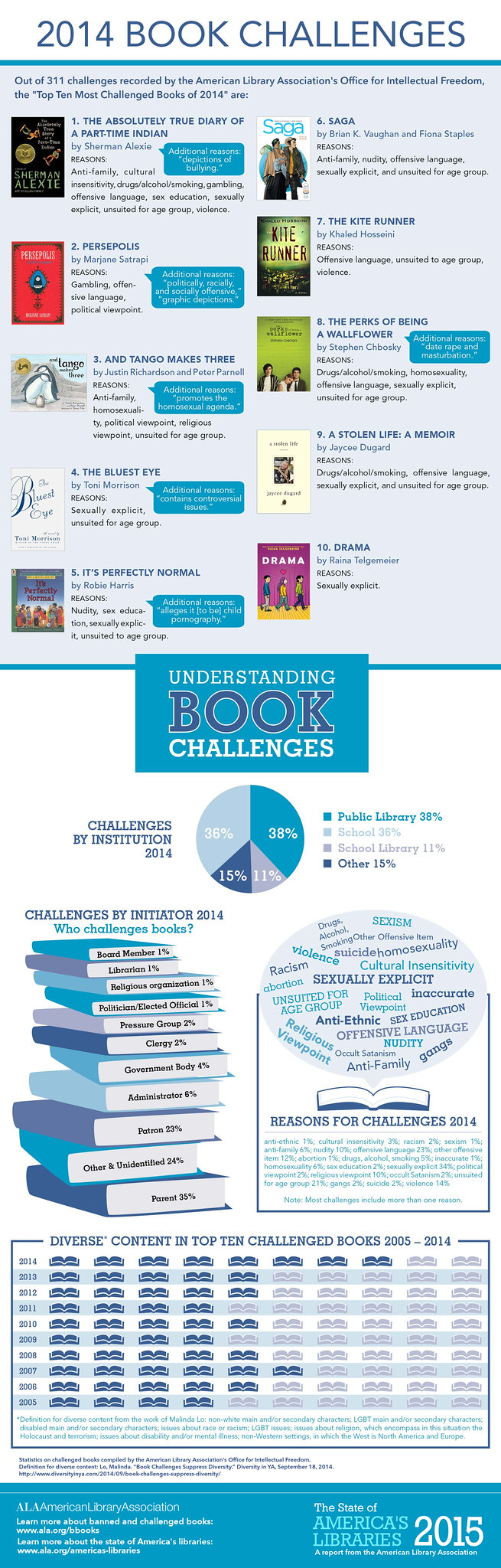


infographic by the ALA

A notable but sad trend that 2015's list illustrates is the over-representation of books about issues concerning diversity. This was also the case in 2014, when the ALA noted that 80% of the most challenged books with "diverse content." To further show this issue, the ALA even created an infographic on this:

Fittingly, this year's Banned Books Week spotlight is on banned books that feature diversity, and I hope that this brings attention to this matter. While people fear the other and the unknown, banning books is perhaps the most counterproductive way to deal with topics that seem strange and frightening. If recent events have taught us anything, it is that insulating ourselves from what is unknown doesn't protect us. Instead, it keeps us ignorant and afraid, and this leads to blind, and often unfounded, anger. Perhaps if, instead of banning books like I Am Jazz or The Curious Incident of the Dog in the Night-Time, it would be helpful to read these texts and get a better sense of other people's perspectives and experiences. To quote Atticus Finch from To Kill a Mockingbird, another book that is a regular on banned and challenged lists, "You never really understand a person until you consider things from his point of view... Until you climb inside of his skin and walk around in it." In other words, rather than avoiding or prohibiting the things that scare us, it's important to face these issues head on and try to gain some empathy, or at least some perspective, on the thing that we fear.

Sunday, September 25, 2011

Banned Books Week 2011

Banned Books Week this year goes from September 24 to October 1. While I might not get to post about it as much as I like (seriously, this semester is slowly but surely killing me), I wanted to give you some resources so you can celebrate banned and challenged books this year.

As always, the ALA has some excellent free resources for schools, teachers, librarians, and other organizations.

The Learning Network at The New York Times (one of my favorite teacher resources) has list of 10 ways to celebrate Banned Books Week.

To get a different perspective on Banned Books Week, Jonah Goldberg had a provocative article in USA Today. While I don't agree with his points (and yes, I've lived in places that have tried to ban books like To Kill a Mockingbird), I do think it is worth a read since it really makes us think about what this week is about.

Tuesday, September 14, 2010

A Banned Book a Day

The Business & Heritage Clarksville is providing commentary on one banned book everyday from September 1 until October 2 (the end of Banned Books Week). This is actually pretty cool (and makes me feel somewhat better about being from Tennessee. Seriously, the Murfreesboro mosque debacle was very disheartening).

Saturday, October 3, 2009

Banned Books Week: Won't Somebody Think of the Children?


It may surprise you (or not) that children's books are often challenged and/ or banned. According to the ALA's "Top Ten Most Frequently Challenged Books of 2008," most of books are actually children's books or young adult literature. From picture books like And Tango Makes Three and Uncle Bobby's Wedding to YAL series like Gossip Girl, children's and adolescent literature seem to be lightning rods for controversy. Perhaps it is because parents (who reportedly lodged 56% of book challenges in 2008) become overzealous when trying to protect their kids, or maybe its because we as a society have a knee-jerk reaction of sheer hysteria when it comes to the very idea that something might be corrupting our youth (see Helen Lovejoy's plea above). Or maybe it is because some tend to underestimate children's and teenagers' ability to comprehend and deal with complex ideas.

Whatever the reasons, here is the ALA's top 10 list. Be certain to read some of them and see (or try to figure out) what all of the fuss is about.
  • And Tango Makes Three, by Justin Richardson and Peter Parnell
    Reasons: anti-ethnic, anti-family, homosexuality, religious viewpoint, and unsuited to age group
  • His Dark Materials trilogy, by Philip Pullman
    Reasons: political viewpoint, religious viewpoint, and violence
  • TTYL; TTFN; L8R, G8R (series), by Lauren Myracle
    Reasons: offensive language, sexually explicit, and unsuited to age group
  • Scary Stories (series), by Alvin Schwartz
    Reasons: occult/satanism, religious viewpoint, and violence
  • Bless Me, Ultima, by Rudolfo Anaya
    Reasons: occult/satanism, offensive language, religious viewpoint, sexually explicit, and violence
  • The Perks of Being a Wallflower, by Stephen Chbosky
    Reasons: drugs, homosexuality, nudity, offensive language, sexually explicit, suicide, and unsuited to age group
  • Gossip Girl (series), by Cecily von Ziegesar
    Reasons: offensive language, sexually explicit, and unsuited to age group
  • Uncle Bobby's Wedding, by Sarah S. Brannen
    Reasons: homosexuality and unsuited to age group
  • The Kite Runner, by Khaled Hosseini
    Reasons: offensive language, sexually explicit, and unsuited to age group
  • Flashcards of My Life, by Charise Mericle Harper
    Reasons: sexually explicit and unsuited to age group

Banned Books Week: Have You Hugged Your Librarian Today?

"And on the subject of burning books: I want to congratulate librarians, not famous for their physical strength or their powerful political connections or their great wealth, who, all over this country, have staunchly resisted anti-democratic bullies who have tried to remove certain books from their shelves, and have refused to reveal to thought police the names of persons who have checked out those titles.

So the America I loved still exists, if not in the White House or the Supreme Court or the Senate or the House of Representatives or the media. The America I love still exists at the front desks of our public libraries."
- Kurt Vonnegut, A Man Without a Country

God bless librarians. While they are often the butt of jokes (imagine the sour-faced spinster shushing teenagers in countless movies), they are also the ones who often stand up to people who try to challenge, ban, or restrict books. Besides that, most of them are extremely cool people who love books, love reading, and love sharing books with others.

Saturday, September 26, 2009

Banned Books Week 2009

Today is the start of Banned Books Week 2009. To kick off the week, here is an awesome video done by the Gottesman Libraries at Columbia's Teachers College. It features the 100 most frequently banned books from 1900 - 2000.

Saturday, October 4, 2008

Banned Books Week: Other Favorites

Art Spiegelman's graphic novel about the Holocaust and his father's experiences in it is one of the great books of modern times. Not only did it help legitimize graphic novels as a form of literature, it also tells a damn good story. In it, Spiegleman uses different animals to symbolize the different ethnicities/races (Jews are mice, Nazis are cats, Americans are dogs, and so on). In addition to telling the story of his parents' ordeal during the Holocaust and World War II, Spiegelman also addreses his complicated relationship with his father (a tempermental miser), his rivalry with a brother who died during the Holocaust, and his guilt with his mother's suicide. However, Maus has come under fire and was challenged in 2005 for being anti-ethnic and unsuitable for younger readers.

As many have discovered, satire can be a hard sell. George S. Kaufman, playwright and satirist, once famously said that "Satire is what closes on Saturday night." While America (The Book) was very popular, two libraries in Mississippi initially refused to put the book on their shelves because it contained (fake) nude pictures of the justices of the Supreme Court. Wal-Mart also decided not to stock the book because of these pictures. When you consider what Wal-Mart does sell, this is an interesting argument. While fake pictures might destroy America, Wal-Mart is dedicated to providing us with firearms and tobacco products

Wednesday, October 1, 2008

Banned Books Week: Literature Edition

While a freakish number of children's books have been banned or challenged, there have been plenty of adult books that have seen the wrath of angry people who spend entirely too much time counting words in the text without actually having read (or understood) the books in questions.

Toni Morrison, who is the first African-American woman to win the Nobel Prize for Literature, is not an author without controversy. Three of her books, Song of Soloman, The Bluest Eye, and Beloved, have all been challenged or banned because of violence, language, and sexuality. Beloved is one of my all-time favorite books, and while I admit it can be a harrowing read, it is also a very powerful one. While parts of the book still perplex me, it also provides incredible insight into slavery in the United States, and it also addresses issues of identity, memory, and guilt. Morrison won the Pulitzer Prize for it in 1988.

Although The Adventures of Huckleberry Finn is considered one of the great books in American literature, it is also one of the most contested books in the canon. In 1885, the Concord Public Library banned the book, saying that the novel was "trash suitable only for the slums." The book's depiction of Huck's behavior and Twain's use of vernacular caused much controversy at the time. Later, in the 20th century, the book came under fire because of its language and racial references. While I can understand how some of the language can make people uncomfortable, most people who challenge the book miss its point. This is not unlike...

Harper Lee's depiction of Depression Era Alabama is a great coming-of-age novel, but this sentiment is obviously not shared by many others, including the student who wanted the book banned because of language or the high school principal who didn't allow a performance of the stage adaptation because of the inclusion of racial slurs and the discussion of rape. However, the challenge that I get the biggest kick out of occurred in Tennessee when I was teaching there. A parent in Williamson County circulated an anonymous (aka cowardly) petition to get the book removed from the public schools there because of language like "snot nosed slut." The petition has so many wonderfully absurd moments that there isn't room or time to go over all of them. The highlights include a list of curses from the book (including "You're damn tootin," a phrase so hilarious that it makes the entire petition look even more ridiculous than it already is) and several quotes from the Bible that supposedly back up this person's protest. I guess that the protester conveniently forgot that, while the Bible is many things, one thing that it is decidedly not is PG-rated. (Incidentally, the Bible has also been banned/ challenged a lot).

Tuesday, September 30, 2008

Looking for Information on Banned Books Week?

If you are interested in Banned Books Week and in banned books in general, here are a few links and resources that could be useful:

The ALA site has a lot of information on Banned Books Week, including...

ALA's list of the Top 100 Banned/ Challenged Books from 2000 to 2007

Both FaceBook and MySpace have pages for Banned Books Week

The American Booksellers Foundation for Freedom of Expression site has a section dedicated to Banned Books Week, which includes a nice listing of books that have been challenged or banned along with the stories behind the challenges/ bannings.

The Forbidden Library also has book listings, information on why books were challenged/ banned, quotes on censorship, and links to other sites addressing the topic of banned books

The Banned Books blog is dedicated to reading and reviewing banned books.

Banned Books Week: Children's Edition

Dort, wo man Bücher verbrennt, verbrennt man am Ende auch Menschen. (Where they burn books, they will ultimately also burn people.)
- Heinrich Heine

I'm a little late (as usual), but this week (September 26 - October 4) is Banned Books Week, which was one of my favorite weeks when I taught high school English. I used to take great pleasure in surprising my students with the books that have been banned or challenged over the years, and it also led to some very interesting discussions regarding age-appropriateness, parents' rights, and the First Amendment. To celebrate this week, I'm going to be blogging about some of my favorite books that have been banned or challenged. To start us off, here are a few childhood favorites that have met with some controversy over the years:

Laura Ingalls Wilder is not immune to being challenged. Her book was challenged for being "offensive to Indians." Little House in the Big Woods was also challenged for similar reasons. While I can try to see the point of banning the book, it is also a historical document which captures an era of time when relations between Native Americans and white settlers were less than stellar. Quite frankly, I'm more offended by the television series and Michael Landon's complete bastardization of the books than I am by the books themselves.


While the challenging of Anne Frank: The Diary of a Young Girl shouldn't be too surprising given some of the more explicit passages, I seriously doubt that anything in the diary is as graphic as what is readily available on the internet or found on network television on a given night. However, the strangest objection to the book was made by four members of the Alabama State Textbook Committe, who deemed the book "a real downer." You can't make this stuff up.


While this wasn't technically part of my childhood, I'm throwing it in anyway. Why? Well, besides being a great book, The Giver was one of the most banned/ challenged books in the U.S. between 2000 - 2007 (at least according to the ALA). Parents have objected to the book's content because it includes infanticide, euthanasia, and violence. However, the best complaint was from one parent who said "This book is negative. I read it. I don't see the academic value in it. Everything presented to the kids should be positive or historical, not negative." There are no words to fully express how awesomely short-sighted this quote is. I can't help but wonder what students are supposed to be reading. Could they read something that was historical and negative? If not, that takes out quite a few books (almost all of Shakespeare's works, The Things They Carried, The Great Gatsby, etc.).
